-
Eleonore Koch: The Essential Painter
-
Mendes Wood DM, New York and Modern Art, London are proud to present two concurrent exhibitions devoted to German-Brazilian painter Eleonore Koch (1926-2018). The exhibitions bring together a group of works produced from the start of Koch’s London period in the late 1960s to paintings executed after her return to São Paulo, in the 1990s.
Please visit Modern Art's Online Viewing Room here.
-
-

Photo courtesy of Eleonore Koch.
-
Eleonore Koch's studio, photography by Luciano Momesso.
-
Born in Berlin in 1926, Koch moved with her family - mother Adelheid, father Ernst and sister Esther - to São Paulo aged ten, in 1936. In 1949, she went to Paris to study art, returning in 1951. In 1960, she moved to Rio de Janeiro and over the decade she traveled to Greece, London and the US. During this period, she exhibited her work regularly in Brazil, although she also held a series of jobs - bookseller, set designer, secretary to influential physicist and occasional art critic Mario Schenberg -, not yet being able to make a living from her art. In 1968 she moved to London, where she would remain until 1989, finally settling in São Paulo until her death in 2018.
This was an unusual trajectory for a Brazilian artist at the time, as most artists who could afford to study abroad returned to the country to pursue their careers. And it was even more unusual for a woman. When Koch arrived in the 'swinging London’ of the 1960s for what would become a twenty year period she was 42 years old, childless and single; in other words, free to move as she pleased. She was, up to that point - and would continue to be -, completely devoted to her work. Furthermore, in 1968 the political situation in Brazil had taken a turn for the worse: the military dictatorship that took power in 1964 issued the AI-5 (Institution Act n. 5), a decree that suspended constitutional rights and resulted in the institutionalization of torture by the State.
The move to a different country seems to have been a sensible option for an artist who felt she had exhausted her professional possibilities in Brazil at a time when political prospects in the homeland were bleak. During a trip to Greece in 1966, Koch made a stopover in London and actively searched for galleries that would exhibit her work, eventually being invited by Mercury Gallery to take part in their summer show. The gallery later informed her of collector Alistair McAlpine’s (1942-2014) interest in sealing an exclusivity contract to acquire her work. Suddenly, there was a concrete opportunity for professional development. The agreement with McAlpine lasted from 1971 until 1977, after which Koch took up a job as a translator for the Scotland Yard. Brazilian art critic Paulo Venâncio Filho recalls her telling him about ‘the peculiar cases she witnessed as a translator for the Scotland Yard in the London courts, without realizing that even more peculiar was to be painter working for the British police!’ In the two decades spent in the UK, Koch’s work was shown in exhibitions at the Portal Gallery (1970), Rutland Gallery (1972, 1976, 1982), Campbell & Franks Fine Art (1978), and Barbican Art Gallery (1983).
-
Eleonore Koch's studio, photography by Luciano Momesso.
-
Regent's Park, London. Photo courtesy of Eleonore Koch.
-
-
-
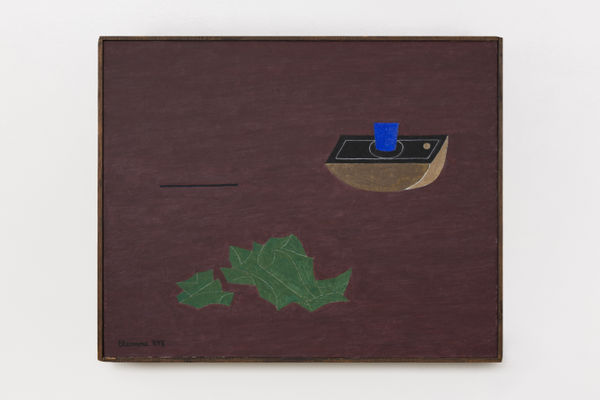
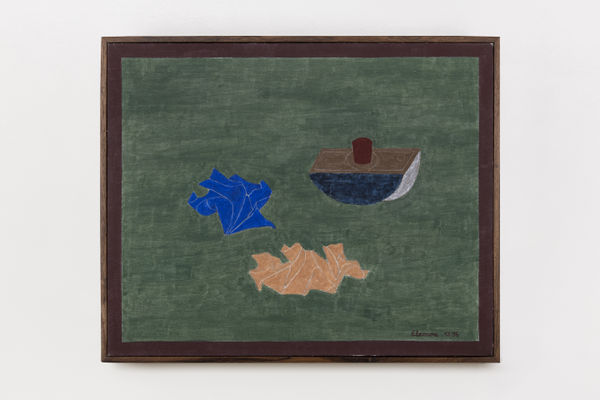
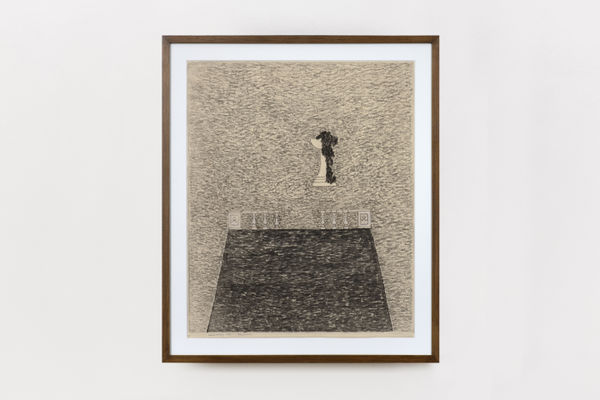
Besides landscape painting, Koch’s strict repertoire only included paintings of interiors featuring mundane objects that don’t appear to have any symbolic value: a blotter, a piece of crumbled paper, a chair, a vase, a peeled orange. At the same time, these objects have been singled out from a multiplicity of others and carefully reduced into synthetic forms that seem to have been sifted through a process of mental distillation which only allows the essential to remain.
The result is far from ‘primitive’ or ‘simplistic’: images that are captured by the eye are submitted to an intense process of analytical deconstruction by the mind; only to be put together again by the hand, at which point they become infused with subjectivity. For Theon Spanudis, this slow mental process reveals Koch’s ability to make everyday objects sacred: ‘Against our profane tendency to use everything as objects for immediate consumption she regains the sacred dimension of the simple object. The ample sensitive spaces (which are not the empty dead spaces of mathematicians and scientists) are part and parcel of her intention to re-sacralize the object lost in the constant flux of mechanical consumption. A secret poetry emanates from her colors, objects, strange configurations and ample and humane spaces. (…) The objects in the seemingly figurative painting of Eleanor Koch are as much subjective as objective beings, fusing these two worlds in a new kind of existence.’
-
-
In an interview published in 1985, when asked about the reasons for relocating to London, Koch stated that she had never achieved anything in Brazil: ‘I was rejected in three editions of the São Paulo Biennale and only managed to be accepted in the fourth because Volpi was a jury member and fought for me’. Although this may not be entirely true, it is certainly fair to say that she had achieved much less than she deserved. By the end of the 1990s, the solitude Koch experienced in Britain was becoming unbearable. In 1989 she decided to finally return to São Paulo, where she passed away in 2018. Over the past decade, Eleonore Koch has slowly started to gain overdue recognition in Brazil. In the UK, it’s been almost 40 years since her work was last publicly exhibited at a group show at the Barbican Art Gallery and it is believed that most of the paintings in McAlpine’s collection were lost during an IRA bomb attack to his Hampshire home in 1990. The two simultaneous exhibitions at Modern Art in London and Mendes Wood DM in New York are therefore a wonderful opportunity to present Koch’s distinctive work to new audiences in both cities.
By Kiki Mazzucchelli, 2020.
-
-
-
Exhibitions organized by Mendes Wood DM, Modern Art, and Almeida e Dale, curation by Kiki Mazzucchelli.
Exhibition photography by Harry Griffin, exhibition video by Matt Scholes.
Photography by Eleonore Koch and Luciano Momesso. Courtesy Orandi Momesso Collection and the Estate of the Artist.